






OLYMPIA CHALLENGE 2026: DISCOVERING YOURSELF AND THE POWER OF ADAPTABILITY IN A CHANGING WORLD
Date Submitted: 11/05/2026
“The only person who is educated is the one who has learned how to learn… and change.”
Carl Rogers, Educational Psychologist
Carl Rogers’ famous quote is not only a reflection on the true meaning of education, but also the educational philosophy that Olympia Challenge aims to bring to life.
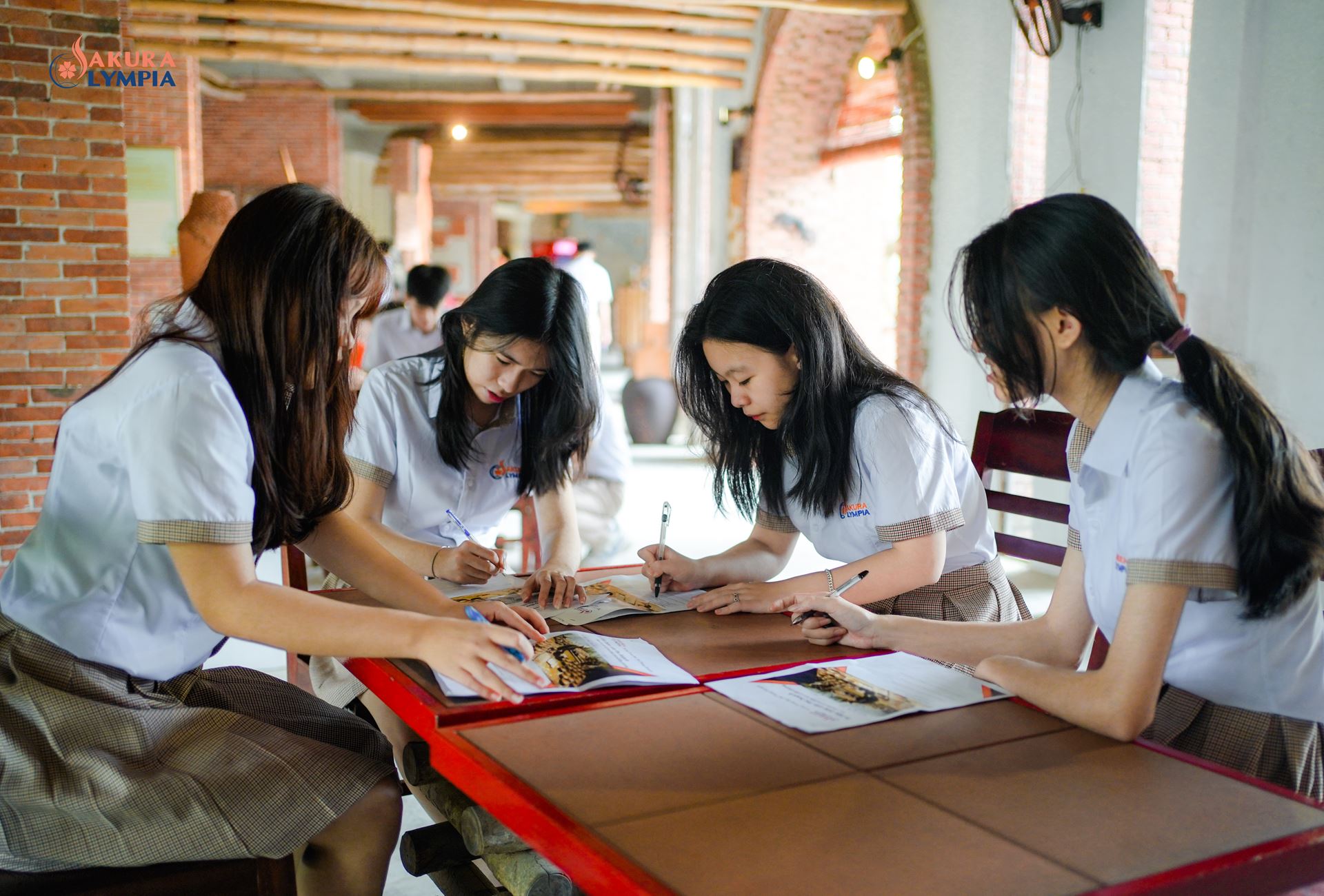
Organized by the Sakura – Olympia School System, Olympia Challenge was created as a unique academic experience for Grade 9 students — young learners standing at an important transition point in their educational journey. Rather than being a traditional test, Olympia Challenge is designed to assess students’ thinking abilities and their use of English in real academic contexts. With the message “Think in English. Solve Real Problems,” the competition encourages students to explore how they think, instead of simply testing what they have memorized.
WHY DO WE NEED A “NEW MINDSET” FOR EDUCATION?
The world is entering a period of major technological and social transformation. According to Elon Musk, artificial intelligence is developing exponentially and may even replace highly skilled professions such as medicine and programming. Meanwhile, the World Economic Forum predicts that 65% of children entering primary school today will eventually work in jobs that do not yet exist.
The rise of automation, globalization, and the knowledge economy has completely changed the rules of the labor market. In this context, traditional learning methods based on memorization and repetition are no longer enough. Olympia Challenge was developed as part of Sakura – Olympia’s educational transformation journey, aiming to equip students with the ability to analyze, evaluate, and create — essential skills that will help them not only adapt to change, but actively participate in shaping it.
THE EXTENDED ESSAY: LEARNING HOW TO WORK WITH KNOWLEDGE
Olympia Challenge consists of two rounds, each designed to assess different competencies. Round 1, The Extended Essay, focused on students’ ability to work with information and transform information into knowledge.
UNDERSTANDING THE TEST STRUCTURE: A THOUGHT-PROVOKING “INFORMATION MATRIX”
The test was designed as an ecosystem of information centered around three contemporary themes: Social Media, E-Waste, and Artificial Intelligence. Rather than asking isolated questions, the four sections were arranged as a connected thinking journey:
Reading Comprehension & Vocabulary in Context: Students were challenged to unpack complex academic texts, moving beyond surface-level understanding to grasp implied meanings and language usage in professional contexts.
Data Analysis & Interpretation: Students worked with raw data and evidence, identifying objective information to support their arguments.
Short Essay Writing – The Point Where Skills Converge: The final section required students to combine all the previous competencies. Attentive students realized that information from earlier sections became valuable “materials” for building thoughtful and well-supported responses.
A PERSONALIZED COMPETENCY MAP
The Round 1 assessment system went beyond scores and rankings. Instead, students received a personalized “Competency Map” focusing on Language Usage, Argument Logic, Data Analysis, and Critical Thinking.
By independently receiving, analyzing, and connecting interdisciplinary information, students learned how to construct knowledge for themselves. This is one of the most important preparations for today’s young generation — helping them avoid getting lost in the overwhelming “ocean” of information in the digital age, while building the independent thinking skills needed to adapt confidently to future change.
THE TOK CLASS: ADAPTABILITY AND CRITICAL THINKING
On the morning of May 9, 2026, Round 2 took place through The TOK Class — an inspiring integrated learning experience that went far beyond the traditional classroom model. Here, the boundaries between subjects disappeared, making room for bigger questions: How do we know something is true? Is the evidence reliable enough?
During an intense 75-minute session, students participated in a unique co-teaching model featuring international teachers from multiple disciplines, including Mathematics, Science, and Language Arts. Instead of delivering answers or direct instruction, the teachers acted as “thought provocateurs,” placing students in situations where real-world data conflicted with scientific evidence. Through this process, students were encouraged to:
Construct knowledge: Build logical arguments based on multidimensional data.
Challenge their limits: Defend their viewpoints before experts instead of searching for a single “right” or “wrong” answer.
Develop adaptability: Collaborate with teammates to solve problems in a constantly changing environment.
Round 2 – The TOK Class was designed as an integrated experiential classroom.
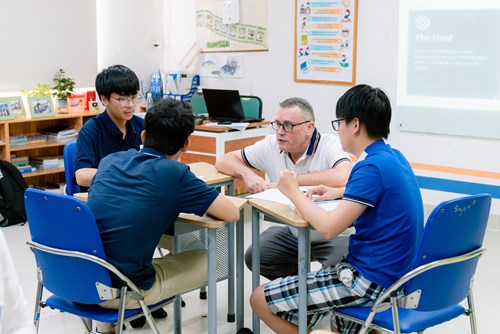
Instead of studying separate subjects individually, students were placed in interdisciplinary challenges guided by international teachers from different academic fields.
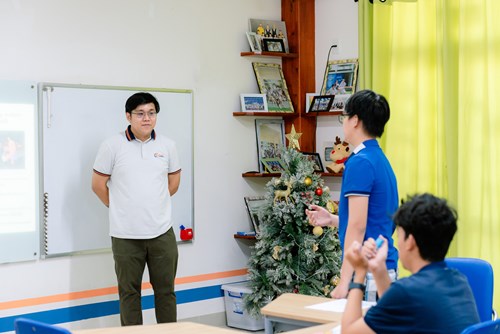
The teachers acted as facilitators who encouraged students to think critically, identify contradictions between data and real-life situations, and explore the nature of knowledge itself.
The 75-minute TOK integrated classroom experience allowed students to truly push beyond their limits. Student feedback after the session reflected a very high level of satisfaction:
“I felt truly satisfied with this morning’s experience because it allowed me to fully express my English abilities.”
Through direct interaction and discussion, students not only demonstrated their English proficiency, but also revealed their ability to adapt flexibly within an academically demanding environment that required strong critical thinking skills.
PARENT SEMINAR: “EDUCATION FOR A CHANGING WORLD”
While students were participating in The TOK Class, parents joined a specialized seminar exploring the future of education. During the session, Dr. Nguyen Thanh Hung, Director of Training and Operations of the Sakura – Olympia School System, shared a thought-provoking reality: we are educating children for a future that even adults cannot fully predict.
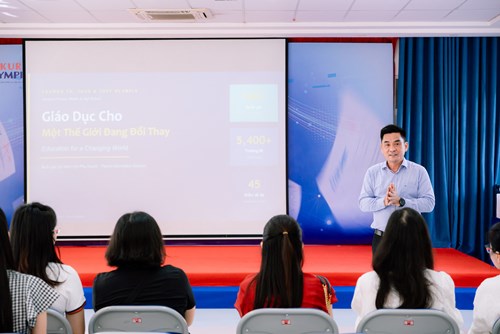
Dr. Nguyen Thanh Hung sharing insights with parents during the seminar.
WHEN THE “STANDARD PATH” NO LONGER EXISTS
At the beginning of the seminar, a striking statistic from the World Economic Forum was introduced: 65% of children entering primary school today will eventually work in jobs that do not yet exist. Even in the period of 2025–2026, careers once considered highly promising — such as basic programming roles — are already being transformed by the rise of AI.
However, artificial intelligence is only one part of the change. Globalization, the knowledge economy’s increasing emphasis on creativity over repetitive labor, and global challenges such as climate change have made the job market far less predictable. In a world where old models are disappearing and new challenges constantly emerge, students’ future careers will no longer follow a fixed path.
WHAT DO STUDENTS NEED TO AVOID BEING “REPLACED”?
As a result of these rapid changes, traditional learning methods based on memorization and repetition are no longer effective. The seminar openly discussed several limitations of conventional education:
Memorizing information is no longer enough: In an age of information overload, students cannot remember everything. What matters more is their ability to receive, analyze, and transform information into personal intellectual assets.
Following fixed patterns is ineffective: When there is no single model for the future, adaptability becomes more important than simply following instructions.
Moving beyond scores and predefined answers: Evaluating students only through questions with ready-made answers — answers that can easily be searched online — has become outdated. Learning now needs to reach higher levels: Analysis – Evaluation – Creation.
Breaking down subject boundaries: Modern careers are interdisciplinary by nature. Students should not only excel in individual subjects, but also learn how to connect knowledge from multiple fields to solve real-world problems.
A SHIFT IN EDUCATIONAL MINDSET
The seminar’s core message emphasized reducing dependence on teachers and nurturing lifelong self-learning abilities. Sakura – Olympia’s goal is not simply to help students “adapt,” but to prepare them to anticipate change, participate in it, and ultimately lead it.
As the philosophy of education shifts from “learning for a fixed career” to “learning to adapt and create,” the partnership between schools and parents in reshaping educational mindsets becomes the key to opening future opportunities for Vietnamese high school students.
HONORING THE CHALLENGE CONQUERORS OF OLYMPIA CHALLENGE
Olympia Challenge 2026 has officially found the deserving winners of its highest honors, recognized through a thoughtful evaluation of research thinking, critical reasoning, and adaptability.
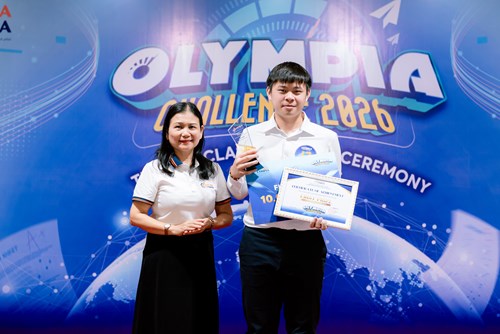
First Prize: Truong Phan Gia Bao (Grade 9 - Sky-Line Primary, Lower Secondary & High School)
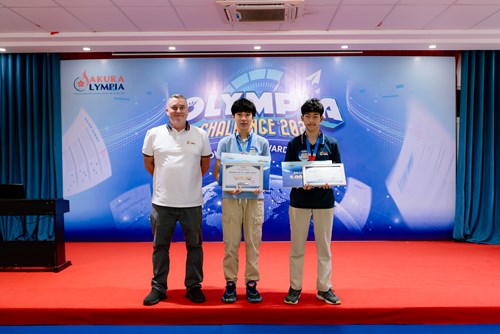
Second Prize: Noah Kazuya Ngo Komuro and Duong Bao Kha (Grade 9 - Olympia Primary, Middle & High School)
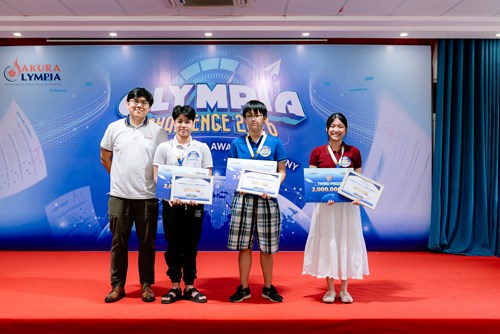
Third Prize: Nguyen Ngoc Bao Tran (Grade 9 - Kim Dong Lower Secondary School), Tran Dinh Tung (Grade 9 - Hermann Gmeiner School), and Nguyen Hoang Khoa (Grade 9 - Nguyen Hue Lower Secondary School)
The prizes have found their rightful owners, but the greatest value gained by every participant lies in the transformation of their thinking and a clearer reflection of their true abilities as they prepare for the future.
Sakura – Olympia sincerely thanks all parents and students for joining us in laying the first foundation stones for a new educational journey.
We look forward to seeing you again in the next seasons of Olympia Challenge!
Secondary News Other

THE CAMBRIDGE LOWER SECONDARY STANDARDIZATION JOURNEY AT OLYMPIA

Summer Camp 2026 "Around the World Quest": A Summer Adventure Around the World Through Science and English
